The way you speak to your children is very important. Whatever temperament God gave you, there will be times when your children will test your patience. This is simply part of God’s design for you that He is accomplishing through your children. It’s common, so don’t be discouraged.
Since I realized the truth about my temper, and my “reactions” I have begun to truly see the truth that an argument cannot continue between me and my children if I stop talking… (this is hard for me). These days, I am putting into practice the truth of what puts out a fire… it’s not fire, it’s water. So, when my child(ren) are heated, I try to stay ‘cool’ and simply discover what the issue is, and ACT accordingly.
I have found, however, that there are specific fires that only grow stronger the more I douse them (this is usually due to a stubborn attitude in the child), and it needs to burn itself out before the child can truly listen to what you have to say. This can be tricky, but sometimes they are “banished” to a place where they won’t catch anyone else on fire… You might call it “time-out without distractions…”
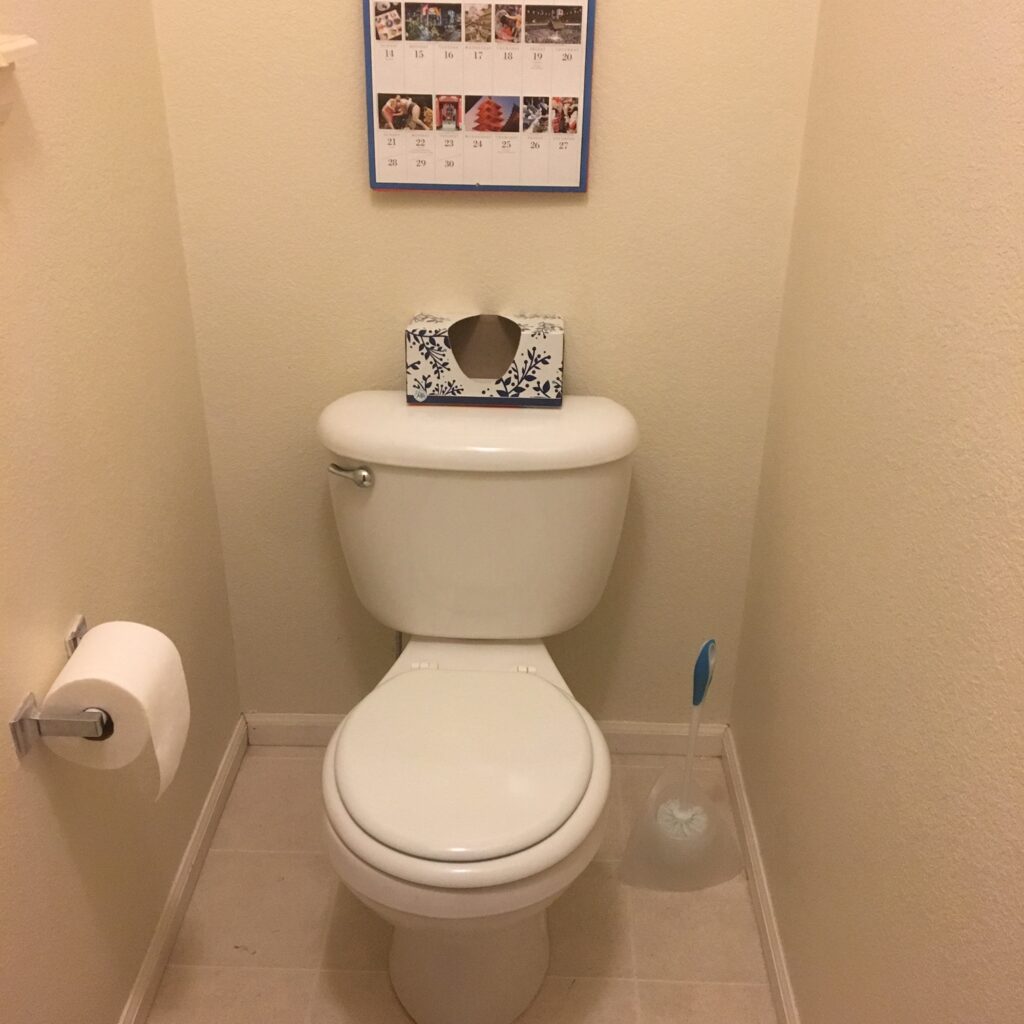
…they don’t get sent to their room, they get sent to my bathroom (the commode is in a room by itself). I have found that there are too many things in their room that lead to them distracting-away the issue instead of being able to come to terms with it. If you do this, be sure, once the fire has burned itself out, to reach a resolution with your child otherwise, it will come back stronger the next time.
The whole reason your children have parents is to help them work through the issues that God allows into their lives and to teach them to do the work themselves. Too often many parents, myself included, take it personally when their children act foolishly… Remember, they are children, foolishness is bound up in their heart. It is normal for a child to start out foolish, your job is to help them through it, not “react” to it.
“Be watchful, stand firm in the faith, act like men, be strong. Let all you do be done in love.”
I Corinthians 16:13
ACT. Don’t React. Be the adult that shows them, by example, how to handle disagreements and disappointments because adulthood is full of these, right?
Have you ever seen someone else’s kids and thought, “I wish my kids were that “chill?” My kids are loud and throw fits, and run all over the place out of control…?” I’ve thought that. The reality that I’ve come to know is that your kids are as chill as you are! Remember those kids … look at their parents, they are like them. It comes down to temperament. There is a difference between temper and temperament.
Now you may say, “Temper? I read your last post and I don’t have an explosive temper.” And if this is the case, great! But know that the explosion is only the expression of what is happening inside. I know parents that don’t explode, but they say things to their children that are harsher than me raising my voice.
Using the word temperament I am talking about habits in how you speak, and what/when you choose to speak. Vengeful, or vindictive, words can cut to the core before you realize it and sarcasm can be a double-edged sword. Depending on your child’s temperament you might be doing damage similar to an explosion of your temper simply by the words you choose to use.
Vengeful, or vindictive, words tear down and can be spoken in a very plain tone yet destroy the hearer more than a punch in the face. My wife has a person in her life that does this on a very regular basis, and it is very, very, difficult for my wife to be in this person’s presence. Often this comes from the need to build themselves up at the expense of the person they are talking to… this is obviously not something we want to teach our children to do by our unspoken example.
Sarcasm is a double-edged sword. Do you use sarcasm to mask the disbelief that your child could have been so foolish!? I have found that often sarcasm used at an inappropriate time provokes more anger in my children than it lightens the situation.
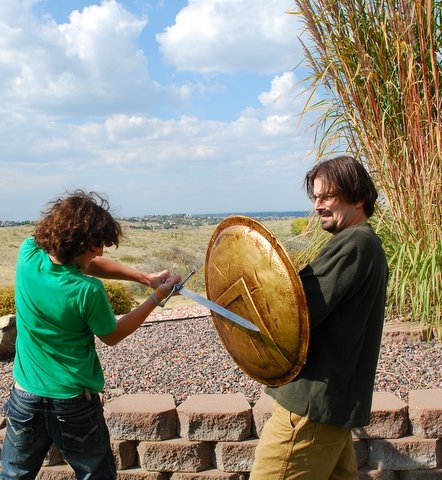
My oldest son Wesley and me posing with replica weaponry.
Sarcasm can be used to enjoy, improve, and foster a relationship by using the opposite side of well-known truths. However, and it’s a big HOWEVER, on the other side of the coin it can be used as a passive-aggressive vent for very valid issues that need a real voice. I have found in my own life that the latter is more often true.
“Like a madman who throws firebrands, arrows and death is the man who deceives his neighbor and says, “I am only joking!”
Proverbs 26:18-19
If this quote from God’s word hit home rather harshly to you, then you may need to rethink how you are using sarcasm with your family. Don’t be afraid to do this. Realizing the issue is the first step to change, and I want to encourage you to take the steps necessary, for your family’s sake. After all, working for the good of your family, and the glory of God, is exactly the course we should be on as fathers!
“A soft answer turns away wrath, but a harsh word stirs up anger.”
Proverbs 15:1
Do your words build your children up, or simply express your displeasure? At the same time, we are also instructed, as fathers not to provoke our children to anger. Take an authentic look at your response to their foolishness and be honest with yourself if you provoke or exasperate them. If your brave enough… ask your wife.
I want to encourage you, here, to look into the way you do react to the foolishness of your children. Do you use edifying words or harsh words? Bursts of anger, harsh words and sarcasm are all temptations we are saddled with as parents, and each of them can drive our children further away, rather than guiding them toward becoming well-rounded adults. We are all tempted to each of these at one point or another, and we most likely have fallen victim to all of them… you are in good company.
Above all, know that your kids will model their temperament after yours. Yes, that can and does mean a temper, but it also means the temperament with which you handle everyday situations will, most likely, be the temperament your children will use when handling the same type of situations. Are you passionate about the things you love, well don’t be surprised if your children talk passionately about the things they love. It also works with things you don’t like. …that’s how it works… it’s how it’s meant to work.
Your children are watching. Demonstrate the temperament you want to see in them (odds are, that is the temperament you want for yourself anyway). This is how you can guide them to be men, or women, of God, treating others the way they want to be treated. This is how you equip your children to be poised to make a difference in this world. Much of the world that will surround them, by the time they become adults, will behave in a manner contrary to these truths. It is your job, Dad, to set your children up for success. Again, (as if I could say it enough) when you fail, allowing your children to see that struggle will give them hope of defeating it themselves when they fail.
You can do this! When you seek your families good, God will strengthen you (he’s already done it) for the work.
My tendency was to explode when things were out of my control (only by the grace of God can I use the past tense). I have had great moments of success with this flaw, and horribly terrifying moments of failure. Through all of this I have discovered that the anger rises up in me when I feel that I am:
Disrespected
Intentionally disobeyed (whether that’s the truth or not)
Not trusting that what is supposed to happen will get done
Rushed
Sounds self-centered, doesn’t it? It is. Looking back, with what I call my ‘sober mind’ (because you can be drunk on anger just as much as you can be drunk on wine), every time I have lashed out, with a temper tantrum (and that’s what they are) it has been for self-centered reasons. This is not love.
The reality is my temper shows up when I’m not trusting that God has allowed the situation that is facing me to be there in the first place. I’m not really mad at the people that are suffering from my lack of gentleness, I’m mad that the situation is out of my control – and I react by sending my thoughts, words, and actions to that same place. This doesn’t accomplish anything except, separate the people that are important to me from the man I’ve worked so hard to become.
Does your temper cause your family to walk on these?
My temper makes me unapproachable. It chips away at my credibility. It causes people to “walk on eggshells” when they are around me, so as to not step on a land mine that will set off an explosion of my temper. It causes my children to be hesitant to bring their concerns, their problems, and their crisis to me because they are not sure how I will “react.” This is the opposite of what we want as fathers.
“Whoever is slow to anger has great understanding, but he who has a hasty temper exalts folly.”
King Solomon, Proverbs 14:29
I have discovered that when my children do, or say, something inappropriate – especially when they are not showing self-control – I rise to their level, and overtake their energy so they will hear my voice over their own and change… this does not work.
Don’t match their energy!
I have found that when I match their energy their fire is simply fueled because I’m trying to fight fire with fire…! When they were smaller, it did work (well… it stopped them from speaking) because I was big, and had a big voice and would literally overshadow them. However, this has led to a pattern of thinking, that has taught my children that if you speak loud enough you will get your point across. I am not proud of this ‘lesson,’ and I’m working now to rectify it (hard work).
I also have discovered that it helps, immensely, to have a plan; to know what to do when ____ happens. If you plan your course of ACTion, you will not leave as much to your emotions, which can lead to your foolishness, when your emotions are driving ‘the train.’ You will never be able to plan for every circumstance that will come up when you are parenting, however, having a handful of examples – that you (and your wife) pre-determine will be your action when your child fails – will make a huge difference in your parenting.
You will inevitably face situations that you are not ready for, and when this happens there is nothing wrong with removing yourself from the situation and deciding on an edifying course of action to be put into place at an appropriate time in the future.
In your plans, and in “those” moments of quick strategy, make sure that the way you ACT is appropriate and God-honoring. Remember, they are watching you and taking mental notes; you are their example of how a man should behave.
A bad temper is like any other sin or character flaw. God’s whole purpose for saving you is to make you more like His Son, which includes exchanging your flaws for His grace! Pray. Ask God to remove your selfish anger; ask Him to remind you of the many reasons, He has already shown you, that you can trust that He’s got this; ask Him to fill you with gentleness. Gentleness is a manly quality – no matter what the world says. If you are full of gentleness, there won’t be any room for a temper.
A fool is not always the village idiot, but also someone who “knows better.”
There is an amazing piece of advice that King Solomon has given us, that seems to be a contradiction, but when you press your mind onto the meaning of this phrase is quite remarkable, and wise:
“Answer not a fool according to his folly, lest you be like him yourself. Answer a fool according to his folly, lest he be wise in his own eyes.” –Proverbs 26:4-5
This relates to an important concept, that we, as parents have to realize. As much as you think highly of your children, much of what they do, or think – while they are children – is folly. The reality of life is this:
“Foolishness (Folly) is bound up in the heart of a child…” –Proverbs 22:15
This is why God gave children parents to watch over and protect them. Do not let your child bring you into their “folly.” Do not let your child think they can manipulate you into always doing what they want in a selfish situation.
These wise words are basically saying don’t “REACT” the same way your children (or the village idiots) are acting because you will just fuel the fire. BUT, “ACT” appropriately knowing of the foolishness that exists, so that they too will see the folly of their ways when reason is brought to light.
When kids speak with all their emotion, they will try to rope you into that emotion. They don’t always do this consciously, but this is precisely what Solomon was talking about. So, be careful not to simply fall into the ‘expendable’ emotion that your children are feeling at the moment.
Remember, you are the adult, and they are watching how your ACT in certain situations – to learn how to respond appropriately when the unexpected, or undesired, situations arise. You can do it! ACT in the midst of foolishness.
The difference between acting and reacting is that one is planned and intentional, while the other can be wrought with unintentional behaviors that bring unintentional consequences that can unintentionally paint you into a corner as a parent, or worse yet, dishonor God with your actions or words. The last thing you want is to unintentionally bring about a deviation from the path that you are trying to keep your child on (are you recognizing a pattern? There are a tremendous amount of unintended things when we “react”).
When we react, there is an automatic response (remember the knee-jerk) that will cause whatever happens to be inside you, at that moment, to spill out. If you are frustrated about a situation happening at the office, your children will no doubt experience your anger about that situation even though they are not involved, if you simply react to them. Of course, you would never “intend” for that to happen, and that is the unwanted pattern to “reaction.” As a parent, you want to do everything as intentionally as possible.
So instead of reacting, ACT according to what your child has brought to the table. Just as you do with people whose opinion of you, you care about – your boss or people at the grocery store. When they interact with you, you simply choose to speak/act in a way that expresses your response to them, even if, at times, they are not completely cordial. This has more to do with your mindset, than your temperament, because whether you explode, speak harshly, or sarcastically to cover your surprise at your children, it can have an adverse effect on them. Therefore, setting your expectations is very important. If you expect your children to fail – expecting is far, far different than hoping that they will – then your disappointment won’t get in the way of how you ACT in the situation because you won’t be caught off guard.
The idea here is to respond to what your child is actually communicating, as opposed to matching the intensity of their passion about what they are saying. One of the greatest things about kids is that they are passionate about what they say, however, it’s also one of the most misunderstood things. Kids attempt to use their fledgling emotions to communicate, which can be a double-edged sword because these emotions are still immature and don’t always appropriately match the situation in their intensity. This also is useful information for you, because the “drama” that comes with every word is relatively “expendable.” For one, they are still learning how to control their emotions, and two, they will swing to another palpable height for their next perception of how life is treating them. In general, it is too often true that:
CHILDREN OVER COMMUNICATE THROUGH THEIR EMOTIONS
Now, please keep in mind, that to them these overexpressed emotions are as real as the day is long. They need to be taken seriously, but not necessarily at the emotional height that your child believes them to be. Therefore, this is not a place to “Make a Big Deal” (as I mentioned earlier), in this scenario the child is already blowing things out of proportion. These moments are where you need to remember that you are the adult that they see and want to become, and therefore it is a perfect time for you to lead them in putting away “childish ways.”
Have you ever noticed that if you speak harshly to your kids they will retort right back with the same tone and aggression? They do, or they will, depending on your tenure as a parent. I also realized a few years ago that my children were reacting to situations that didn’t go their way in a manner that concerned me, only to discover that I had taught them to do it.
Not only had I taught them to react poorly to unexpected outcomes through my own example, but when they did this I was compounding the problem because I would react to them reacting, and soon we were all yelling. The thing I have learned, and want to share with you over the next few posts is this:
Act. Don’t react.
What do you think of when I say the word ‘reactor?’ I think of a bomb! A Nuclear Bomb to be exact. The reactor is the part that is unstable, and very dangerous. I think of men in Haz-Mat suits and thick rubber gloves treading lightly because of the uncertainty of the condition of the core.
Is that you?
Does your family tread lightly, or walk on egg-shells when they speak to you because of the possibility of a hazardous situation? I am ashamed to say that there was a time where mine did. I thought that I needed to meet disobedience and backtalk with the proverbial “foot down” and address my children in a tone that showed who was boss. I realized, however, that I was exacerbating the problem because I was being an example of the opposite of how I wanted them to behave!
Act. Don’t react.
I have also heard it said, respond rather than react. In either phrase, the idea is to be thoughtful and intentional with your actions, rather than letting someone else dictate how you behave. Do you meet your children’s intensity, or do you set the intensity for the conversation? You, as the adult have a better understanding of where that level should be.
Another way of saying this is by using the cliché term “knee-jerk reaction.” If you look at the concept of this phrase, and its origin, you see what they call an “automatic response.” We’ve all been to the doctor to get a physical, and there is a point when he asks you to sit down with your legs hanging freely, he pulls out his little rubber hammer and gently taps the tendon below your knee. There is an immediate rising of the lower part of your leg. It’s a “knee-jerk.”
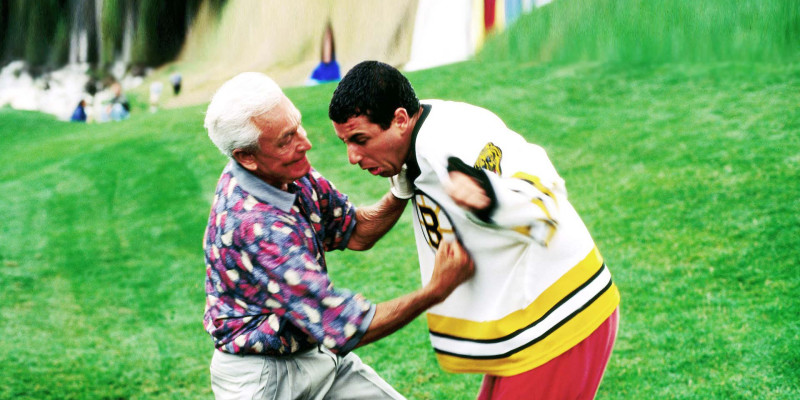
When I think of “knee-jerk” reaction, I see someone getting punched in the stomach, and their knees jerking up toward their face in a seizing of their abdomen because of the pain, pulling all the muscles together and thus “folding” that person in half like a table… and what is the response when someone punches you in the stomach? Anger. But remember, the concept here is to avoid the fighting, avoid the yelling, and edify your child(ren) because you are the adult.
The moments when your children actually punch you in the stomach are less than the moments these analogies are relevant. Your kids will fail. Do you explode when they do? It’s important for them to know that they can talk to you when they fail. They will also speak to you inappropriately – they’re kids. I’m not saying allow them to do so, but don’t allow them to shape your attitude, based on their foolishness. Your job is to shape theirs.
In general, when we are diligent to disallow others from shaping our attitudes and actions we are setting a great example for our children who want so desperately to become adults. You can do it! Pray for the Lord to help keep you from “reacting” or “knee-jerking” because this only causes further problems.
The basic idea of what kind of a man your daughter will want, or your son will desire to be, is a byproduct of your example in practical areas of life (not just the “big” areas). It is who you are in everyday life.
You set an example of the way to take up responsibility. You establish the importance honest plays in dealing with those around you. You demonstrate the amount of hard work necessary to build the life you desire (they will expect). You set the precedent on the advantage, or disadvantage, of being kind and generous. You set the mark for the importance of loyalty; the reward of pressing on; the value of believing in something.
Your convictions will be their convictions, that’s how it’s designed. You are an example and they will follow, but keep in mind they will follow, so if there is some “you work” to be done – so that your example is what you want them to follow – take up the responsibility for that truth and take care of it.
My “Gem” with a beautiful view, on a road-trip to Oregon.
Whether you want to be or not, you are the most important example in your child’s life.
My Wife and I, with that same view. (My kids wanted their pictures because we got ours… our example)
I challenge you to intentionally set, for them, an example of a God-honoring man, for His glory, but also so that what your children observe when they look to you is what a man was intended to look like. Then they will not be duped by this society that seems bent on eradicating true manhood from its ranks. If you didn’t have a good example to pattern your life around, change the pattern (you can do it – and know that there are men out there willing to help you), and intentionally be an example for your children. Show them what it means to be a man!
*still wondering what I mean by “what it means to be a man” click here for the pattern I used.
This past Saturday I stopped by The Home Depot on my way home from dropping “Cap” (my youngest son) off at work. I picked up a cartridge I needed to fix the kids’ bathroom sink and a replacement flapper for the toilet downstairs. On my way home from “The Depot,” it was brought to my mind that the cartridge may not be the entire problem in the sink and that I may have to replace the seat and seal as well. I kept that in mind.
By the time I made it home, “My Jewel” ( my youngest daughter – now 12) was up and ready to talk to me. I set aside my projects for a few moments and caught up on how the previous evening had gone and the things she was thinking that morning. I then proceeded to the bathroom to fix their sink. She followed and watched me put in the new cartridge. It still leaked. As I continued to interact with My Jewel I removed the device and extracted the seat and seal, underneath – remembering that this might be the real problem. It was. I could see a rip in the rubber. With the old seat and seal in my pocket, My Jewel and I returned to The Home Depot.
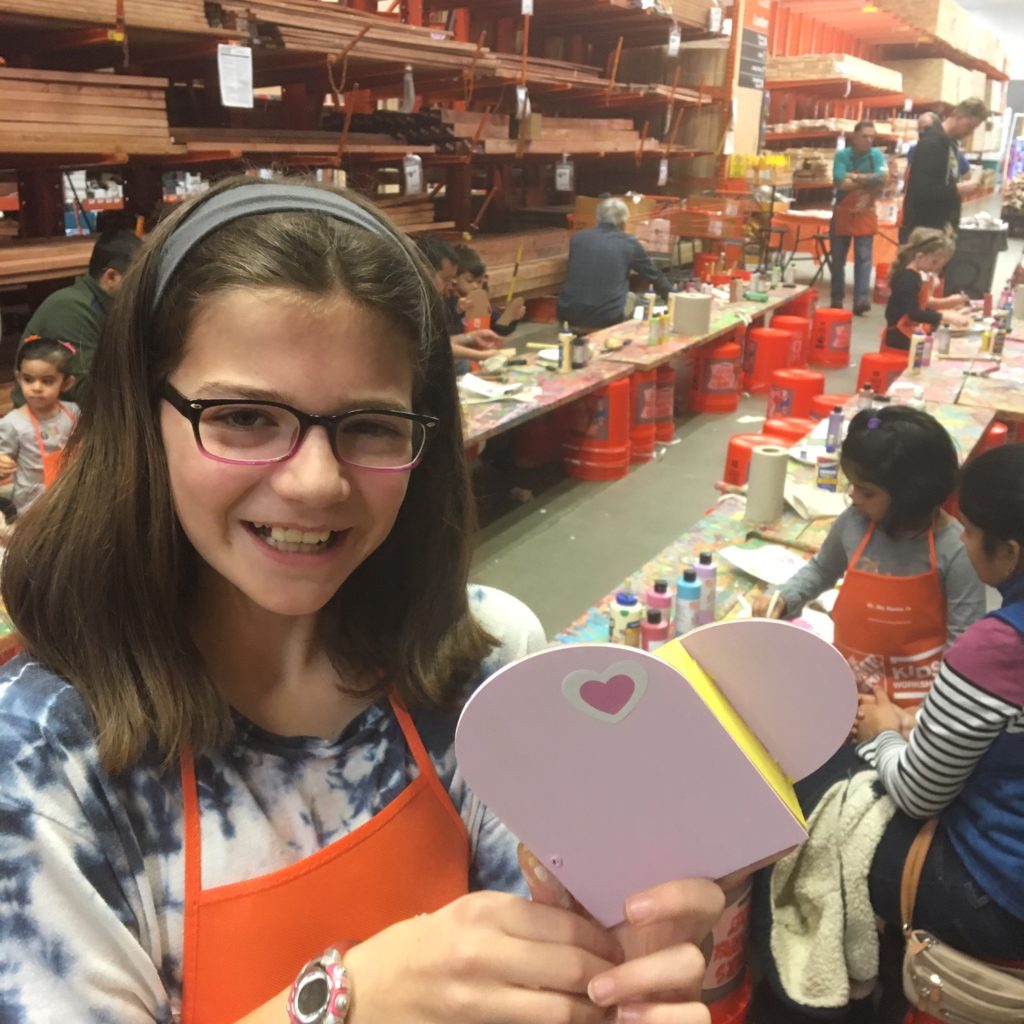
The Home Depot runs a Kids Workshop, the first Saturday of every month, where they allow kids to make small wood projects… and it’s free! (but register online so they know how many supplies they need 🙂 ) I had heard of The Home Depot Kid Workshops years before and had often thought about taking my boys when they were younger, but the workshops had left my radar once the boys were building things on their own.
My Jewel is very crafty. Not in the sly devious way, but in the inventive ingenuity way. She will often take something from the trash and make a clever thing from it. On my first trip to “The Depot” I noticed the Kids Workshop being given but didn’t think twice about it. Well, this time she noticed it.
You know those times when your child makes their presence and interest known, by staring at something longer than “normal?” That is exactly what happened. The alarms started going off in my head, and I realized that she would like to participate in the hammering that was echoing through the store.
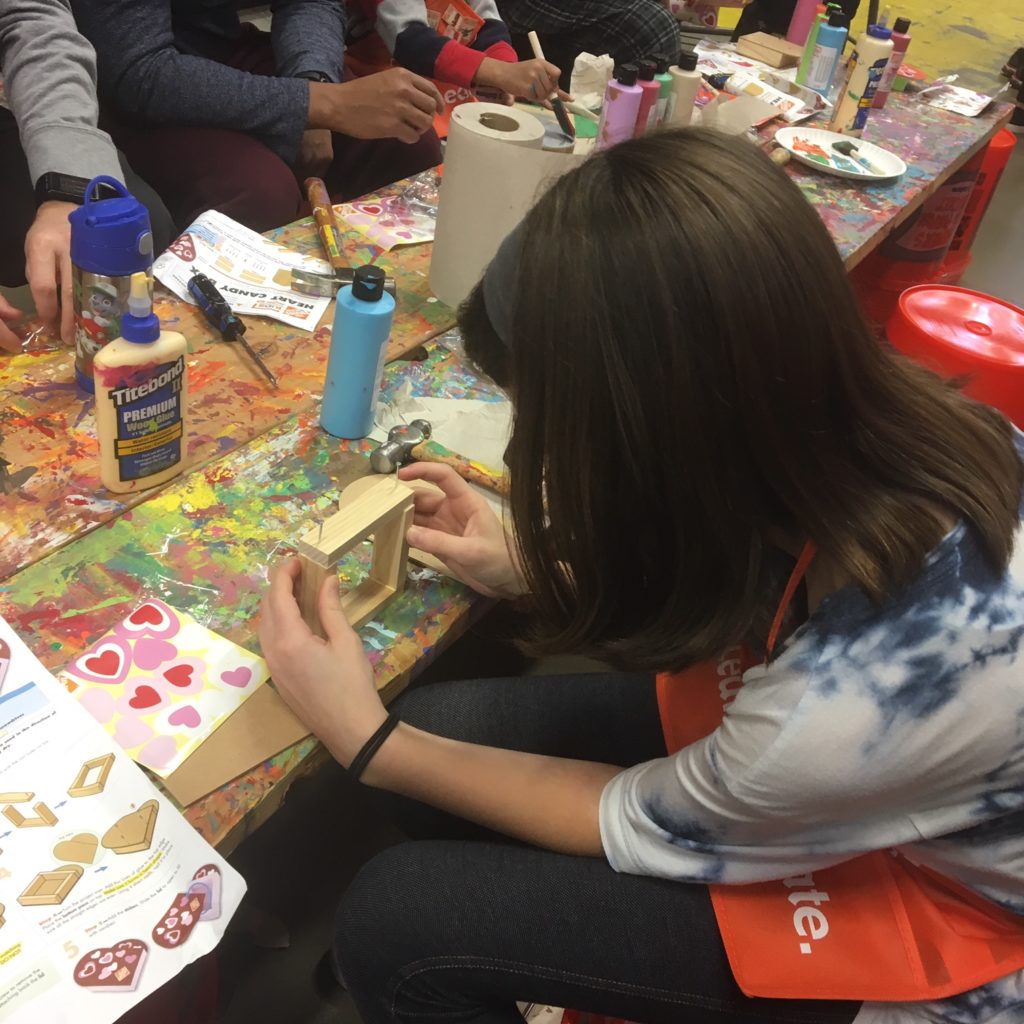
My Jewel putting the box together!
So I called my wife, to let her know we would be delayed, and My Jewel spent the next forty-five minutes making a Heart Shaped Candy Box. She even got a small apron and a pin to pin on it (perhaps just as cool as the project – in her mind). When she was finished with the box, I confirmed the timing of these events – that they were on a monthly basis. Her eyes lit up with the prospect of coming back and making something else next month. She even thought about how “cool” it would be to have multiple pins on her new apron. When we got home she went straight to the drawer and got a sharpie to write her name on her new apron!
My Jewel with her Heart Shaped Box Project
This just reminds me, yet again, as dad’s we need to always make time for the unexpected opportunity to pour into our kids and their interests.
The tremendous impact we have, as fathers, over the minds of our children starts simply in the way we carry ourselves. From the time our children are born they are observing us and framing their idea of what a man is, based on what they see in us.
Laurel House, a Dating Coach for a group called Healthy Living told sheknows.com the following:
How you were treated by your father as you were growing up helps shape your view of men in general and what you expect from them. “It isn’t that a woman is necessarily choosing to date a man like her father, but instead she has learned to love that kind of man, because that was the first feeling of love that she has ever had for a man. It’s a standard that is set.”
Wow! …and Ms. House is coming at the subject from the opposite end of the moral compass than I am. Her views on dating and life in general are not ones that I necessarily agree with, but when I happened upon this quote the universal truth was reiterated that girls marry men like their father. Ms. House is an international celebrity dating and relationship coach explaining what she so readily sees while working with women who are seeking a relationship with a man. And from her perspective too, girls marry men like their father.
My Halloween costume last year (Dr. Jekyll…
This reality can set up a daughter for wonderful success, or for massive failure. Do you want your daughter to marry a drunk? An addict? Or a monster that might physically hurt her? You are writing a pattern on your daughter’s heart, right now, for a man who expresses himself the same way you do. I tend to let my temper out from time to time in a loud boisterous way, that has scared my family in the past. The following was a sobering thought to me:
…and Mr. Hyde
“If my daughter is attracted to a man who struggles with controlling his temper and yet doesn’t have the physical restraint that has been trained into me, he might beat my baby girl!”
Do you ever wonder why girls can be attracted to the “bad boy type” or stay with a man who is hitting them? It is not that their father was exactly the same, but it may often be that her father exhibited a small portion of such behavior (as I have) and the pattern written on her heart isn’t catching the differences.
The next time you recognize your children behaving like you – good or (more often) bad – keep in mind that imitation is the highest form of flattery. They are hard-wired to look up to you, and they are imitating your behavior because they think very highly of you, you’re their hero!
On the flip side, understanding that you are writing a pattern on your daughter’s heart, you can build-in a firm desire for a man who appropriately leads his family and takes care of his wife.
Children will learn more through observation than pontification.
This, spoken from a “grand pontificator!” Most of the time your children don’t want to hear your reasoning behind every guideline you set up, or how many times you’ve had to reprimand them for doing something they already know is wrong.
A Grand Pontificator! (not me)
It makes much more of an impact to watch dad be responsible, honest, and hardworking than to hear him talk about it. If they see you do it, they are much more apt to follow. Now, I’m not saying don’t ever talk about it, because it is necessary to explain what and why, but leave the “soapbox” under the bed.
My Jewel and I
Children are much better at imitating something that they have seen than obeying a rule or spoken command. Not to mention that when you pontificate (lecture… preach… elaborate) on a regular basis, even with a righteous subject matter, your child(ren) will grow dangerously tired of it, and you will begin the descent toward exasperating them all the quicker. Personally, I tend to remind them how often they do, whatever it is that I am reprimanding them for at the time. This is completely contrary to the idea of love being “patient and kind, not being arrogant or rude, and keeping no record of wrongs.” I can say, that I have recognized that the more you can be an example of not holding a grudge, the better your child(ren) will have a chance to escape the gripping sin of unforgiveness.
Above all, and I’ve said it before (and will probably say it again) when you fail to do what you plan to do, for their sake, let them know that you recognize your mistake and are working to rectify it.